Number 1 - Return
Return - the removal of people from the UK to countries where the Home Office determines they belong.
(This is the first post in a new thread called A Lexicon of Exclusion. This thread will consider what the Home Office's terminology (really) means. What are the messages the HO sends through its choice of words? How are these terms interpreted in public discourse and what might using them mean for the people described by them?)
The British Home Office publishes data on people 'Returned from' the UK as part of the immigration statistics quarterly release. It's website states it "... seeks to return people who do not have a legal right to stay in the UK to another country.” Unsaid, but hovering behind the Home Office’s use of the term ‘Return’ is the phrase ‘… to their country of origin’ or perhaps ‘… back to where you belong’.
Home Office statistics categorise 'Return' as voluntary, enforced or port return. Of these, it is only voluntary return which grants the returnee any agency in how they leave the UK and even that, may be very limited. An individual or family may have been subject to the pressure of the hostile environment for months or years before eventually 'choosing' to leave the UK. Voluntary return can a positive choice supported by a small amount of money, training or other help to re-integrate, but may also represent the giving up of an unequal struggle to realise dreams of a better life.
The meaning of an enforced return is clearer. Someone, who has perhaps been living in the UK for many years, is forcibly evicted from the country. This person does not want to leave the UK. They may have lived here for a few months or, more likely, for several years – perhaps since they were children. Return may occur after a deportation order has been issued by a Court but is more likely to be an administrative removal - by which the state determines a person or family has no right to remain in the country. Enforced returnees may have been detained and/or have lived under immigration control for years. They may fear being sent back to countries where they have previously experienced and escaped persecution and where they expect more of the same. Enforced return may mean taking children out of school or it might mean leaving children, spouses and community behind. Enforced return can be brutal and returnees may be shackled and physically forced onto planes as described recently by Hugh Muir in a first-hand report for the Guardian newspaper.
The third category of Return, port return, describes the experience of a person rebuffed by immigration officials at a port of entry. They might not even have stepped onto British soil as these returns often happen outside of the UK, for example at the Eurostar terminals in Paris and Brussels or in the no man’s land of international airports. These returnees may have crossed a physical, geographic boundary onto the British Isles or may have merely stepped over a virtual line into a pre-departure border control area marked by an official in a box with flag on it. Port returns are 'enforced' in that they cannot be challenged except, in some circumstances, by claiming asylum. There is no right of appeal. People returned, or rather refused entry, at the port, have somehow caused the border official to use their discretionary powers to refuse entry. They must look, to the official at least, like someone who intends to break the law. They appear to be the sort of person who will to work illegally, overstay their visa or otherwise abuse the hospitality of the UK.
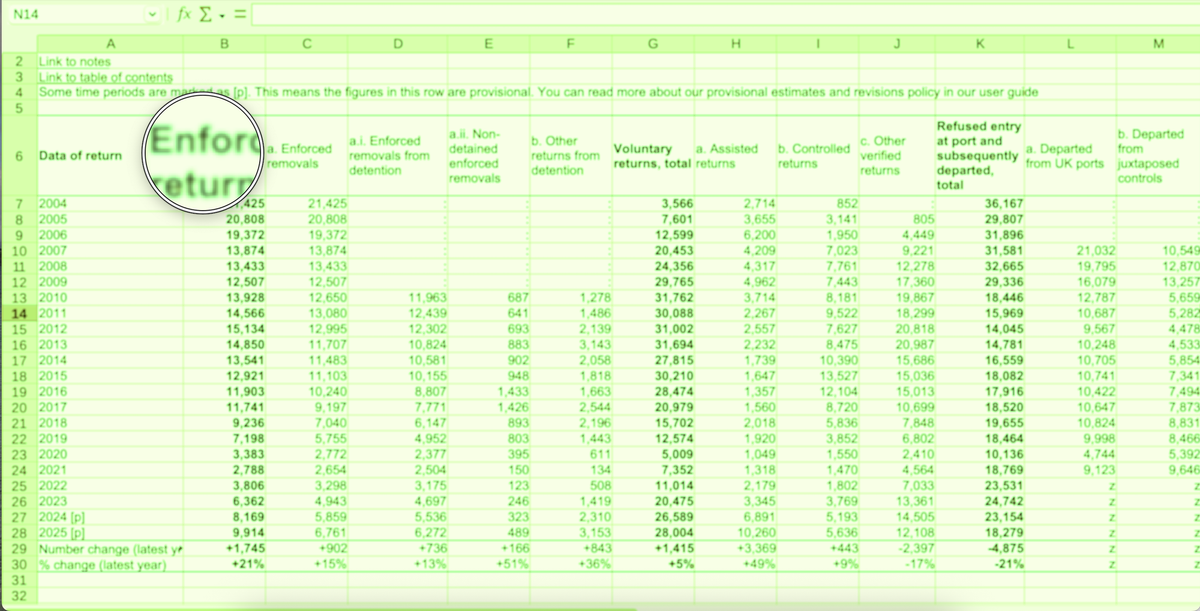
For those of you who like statistics, (and who doesn’t?), the Home Office produces data on Returns. These show that as well as the nearly 10,000 enforced returns and 28,000 voluntary returns there were 18,279 returns from UK ports during 2025. The largest nationality returned were Romanian citizens (5,222 individuals). Bulgarians and Brazilians were also returned in significant numbers (1,711 and 1,092 respectively) along with 531 French, 523 US and 301 German citizens. This list of nationalities shows that holders of passports usually welcome in the UK can be refused entry and face Return from the UK. Border officials are using their ‘discretionary powers’ so we don't know why individuals are refused entry at the port. Perhaps I’m overthinking this, but is the urge to use these powers more likely to be piqued by foreign citizens of colour than by their white counterparts? I don't know, I hope not.
Undeniably, what these three types of Return show is that established rights to enter, live, work, study, build a family in the UK are insecure and can be withdrawn. Rights that were once permanent are increasingly impermanent. Foreign citizens resident in the UK are all on notice that the State can use Return mechanisms to wash its hands of them if it chooses to. Britain's pioneering work on the stripping of citizenship from dual nationals and the narrative of an ‘earned’ right to remain just add to the insecurity and vulnerability many people in the UK live with day to day.
For some people who are Returned from the UK, their connections, and their sense of belonging, may be slight. They may only have the phone number of a friend of a friend, an advocacy group or a solicitor. The only British person they may have met may be a Visitor at a detention centre or a staff member in an asylum hotel. But for many, if not most returnees, their connection to UK society is deep, intimate, meaningful and freighted with hope and future aspiration. They will be missed in the UK. Children will miss parents, families will miss cousins, sibling and grandparents; communities will miss friends, supporters, professional and volunteer workers. Return denies the months and years a person might have lived in the UK and enforced and, in many cases, voluntary return insists that people make their lives somewhere else.
Above all, 'Return' insists that people do not belong; that they can never belong and that they have always, intrinsically, been part of some other place where they will be sent willingly or unwillingly.